Welcome to Comic Book Plus, a massive site where every day is party day!
We are the original, and still the best site to read and download Golden Age comic books. We also hold a large and growing selection of Silver Age comic books, Comic Strips, Pulp Fiction, Old Time Radio (OTR), Fanzines, a lively and active Forum plus lots more ...
The even better news is that all the content is FREE and LEGAL.
This is a historically significant archive, that has taken a great many people thousands of hours to create, and we are ever vigilant to ensure that no content breaches copyright or trademark laws.
There is something for everyone here. We hope you enjoy your time with us, and come back really soon!
You are WELCOME to enjoy our site & read ALL our books online. But to download & join our forum please create a FREE account or
login
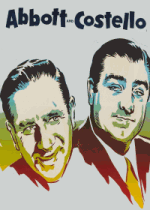
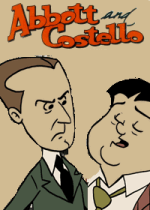
Abbott and Costello's first known radio appearance was on The Kate Smith Hour in February 1938. Initially, the similarities between their voices made it difficult for listeners (as opposed to stage audiences) to tell them apart due to their rapid-fire repartee. The problem was solved by having Costello affect a high-pitched childish voice. "Who's on First?" was first performed for a national radio audience the following month. They stayed on the program as regulars for two years, while landing roles in a Broadway revue, The Streets of Paris, in 1939.
In 1940 Universal Studios signed them for the film One Night in the Tropics. Cast in supporting roles, they stole the show with several classic routines, including "Who's on First?" The same year they were a summer replacement on radio for Fred Allen. Two years later, they had their own NBC show.
The Abbott and Costello Show mixed comedy with musical interludes (by vocalists such as Connie Haines, Ashley Eustis, the Delta Rhythm Boys, Skinnay Ennis, Marilyn Maxwell, and the Les Baxter Singers). Regulars and semi-regulars on the show included Artie Auerbach ("Mr. Kitzel"), Elvia Allman, Iris Adrian, Mel Blanc, Wally Brown, Sharon Douglas, Verna Felton, Sidney Fields, Frank Nelson, Martha Wentworth, and Benay Venuta. Ken Niles was the show's longtime announcer, doubling as an exasperated foil to Abbott and Costello's mishaps (and often fuming in character as Costello routinely insulted his on-air wife). Niles was succeeded by Michael Roy, with announcing chores also handled over the years by Frank Bingman and Jim Doyle. The show went through several orchestras during its radio life, including those of Ennis, Charles Hoff, Matty Matlock, Matty Malneck, Jack Meakin, Will Osborne, Fred Rich, Leith Stevens, and Peter van Steeden. The show's writers included Howard Harris, Hal Fimberg, Parke Levy, Don Prindle, Eddie Cherkose (later known as Eddie Maxwell), Leonard B. Stern, Martin Ragaway, Paul Conlan, and Eddie Forman, as well as producer Martin Gosch. Sound effects were handled primarily by Floyd Caton. Guest stars were plentiful, including Frank Sinatra, The Andrews Sisters, and Lucille Ball. (Source: wikipedia.org)
William "Bud" Abbott and Lou Costello were an American comedy duo whose work in vaudeville and on stage, radio, film and television made them the most popular comedy team during the 1940s and early 1950s. Their patter routine "Who's on First?" is considered one of the greatest comedy routines of all time and set the framework for many of their best-known comedy bits.
After working as Allen's summer replacement, Abbott and Costello joined Edgar Bergen and Charlie McCarthy on The Chase and Sanborn Hour in 1941, while two of their films (Buck Privates and Hold That Ghost) were adapted for Lux Radio Theater. They launched their own weekly show October 8, 1942, sponsored by Camel cigarettes.
On December 8, 1941, a day after the attack on Pearl Harbor, Abbott and Costello had their prints set in concrete at what was then "Grauman's Chinese Theatre". In 1942, they were the top box office draw with four films earning a total of $10 million. They remained a top ten box office attraction until 1952.
In 1947 Abbott and Costello moved the show to ABC (the former NBC Blue Network). During their time on ABC, the duo also hosted a 30-minute children's radio program (The Abbott and Costello Children's Show), which aired Saturday mornings, featuring child vocalist Anna Mae Slaughter and child announcer Johnny McGovern. (Source: wikipedia.org)
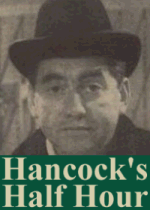
Hancock's Half Hour was a BBC radio comedy, and later television comedy series, broadcast from 1954 to 1961 and written by Ray Galton and Alan Simpson. The series starred Tony Hancock, with Sidney James; the radio version also co-starred, at various times, Moira Lister, Andrée Melly, Hattie Jacques, Bill Kerr and Kenneth Williams. The final television series, renamed simply Hancock, starred Hancock alone.
Comedian Tony Hancock starred in the show, playing an exaggerated and much poorer version of his own character and lifestyle, Anthony Aloysius St John Hancock, a down-at-heel comedian living at the dilapidated 23 Railway Cuttings in East Cheam.
The series was influential in the development of the situation comedy, with its move away from radio variety towards a focus on character development.
The radio version was produced by Dennis Main Wilson for most of its run. After Main Wilson departed for his television career, his role was taken by Tom Ronald. The television series was produced by Duncan Wood. The distinctive tuba-based theme tune was composed by Angela Morley, then known by her original name, Wally Stott.
The radio series broke with the variety tradition which was then dominant in British radio comedy, highlighting a new genre: the sitcom or situation comedy. Instead of the traditional variety mix of sketches, guest stars and musical interludes, the show's humour derived from characters and situations developed in a half-hour storyline. This then relatively novel format, of what was in effect a single sketch each week lasting the entire half-hour (though in the radio version James and the others sometimes played different roles), was reflected in the show's title, which aptly described the series as Hancock's "half-hour".
The comedy gradually shifted to observation, with a less strong emphasis on a narrative.
Most of the radio episodes were recorded between one day and three weeks in advance of broadcast, except for Series 6 which was mostly recorded during a three-week period in June 1959 in order to avoid clashing with the recording of Series 5 of the television show.
Galton and Simpson never gave titles to any of their Hancock scripts, for radio or television; this was usually left to the girl who filed the scripts at their office, who gave them names that were a reminder of what the script was about.
The regular cast members generally played "themselves", in that the characters were called by the actor's real name (although the English actress Andrée Melly sister of George Melly played a French character). However, there were exceptions:
Kenneth Williams played a series of unnamed characters referred to in the scripts - but not on air - as "Snide". He also played the very occasional roles of Edwardian Fred (a criminal associate of Sid's) and Hancock's Vicar, as well as various other characters. In the episode "The Emigrant" he is allowed to break the fourth wall and refer to himself as "that bloke with the funny voice".
Hattie Jacques played Griselda Pugh, Hancock's secretary, with the exception of the episode "The East Cheam Drama Festival" where she played herself.
Alan Simpson played an unnamed man in early episodes who listened patiently to Hancock's long-winded stories. His lines would frequently be restricted to simply "Yes", "Really?", "Mm-hmm", or "I see". (source: wikipedia)
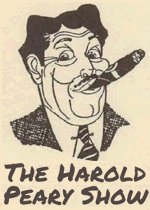
The Harold Peary Show is a radio situation comedy broadcast in the United States September 17, 1950-June 13, 1951 on CBS. Some sources refer to the program as Honest Harold or The Hal Peary Show.
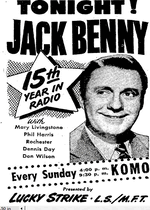
The period 1948-1950 brought major changes to network radio, as CBS hired a number of stars from NBC in what some have called "talent raids". Some of the top performers who changed networks were Jack Benny, Red Skelton, Edgar Bergen, and the husband-and-wife duo George Burns and Gracie Allen. One result of the changes was that 12 of the 15 highest-rated radio programs at the end of 1949 were on CBS.
Harold Peary did not find such success, however. Peary switched to CBS, while the program in which he had starred, The Great Gildersleeve, stayed on NBC. Those changes resulted in a new program (The Harold Peary Show) for Peary and a new star (Willard Waterman) for Gildersleeve. Radio historian John Dunning commented that The Harold Peary Show "failed to gain any measure of an audience in its lone season".
The Harold Peary Show featured a radio show within a radio show. The main character, Harold Hemp -- called "Honest Harold," was host of a program called "The Happy Homemaker". As one would expect from a situation comedy, humor arose from Hemp's interaction with other characters in the episodes. They included his mother, his nephew, a marshal, a doctor, the radio station's switchboard operator, and girlfriends. (source: wikipedia)
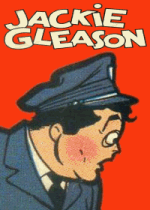
John Herbert "Jackie" Gleason (February 26, 1916 - June 24, 1987) was an American comedian, actor and musician. He was known for his brash visual and verbal comedy style, exemplified by his character Ralph Kramden in The Honeymooners. Among his notable film roles were Minnesota Fats in the 1961 drama The Hustler (starring Paul Newman) and Buford T. Justice in the Smokey and the Bandit series.
Gleason disliked rehearsing. With a photographic memory he read the script once, watched a rehearsal with his co-stars and stand-in, and shot the show later that day. When he made mistakes, he often blamed the cue cards. During the 1950s he was a semi-regular guest on a paranormal-themed overnight radio show hosted by John Nebel, and wrote the introduction to Donald Bain's biography of Nebel. After his death, his large book collection was donated to the library of the University of Miami.
For many years, Gleason would only travel by train; his fear of flying arose from an incident when he had only minor movie roles. Gleason would fly to Los Angeles for movie work, then back to New York when his roles were completed. After finishing one of his movies, the comedian boarded a plane for New York. Two of the plane's engines cut out, and the pilot made an emergency landing in Tulsa, Oklahoma.
Gleason smoked four packs of cigarettes a day. In 1978 when he suffered chest pains, forcing him to leave the show in Chicago and undergo triple-bypass surgery. Gleason delivered a critically acclaimed performance in the comedy-drama Nothing in Common (1986). It was Gleason's final film role, since he was suffering from colon cancer, liver cancer, and thrombosed hemorrhoids. On June 24, 1987, Gleason died at his Florida home. (Source: wikipedia.org)
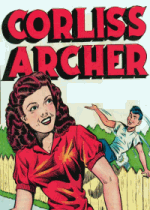
Meet Corliss Archer ran from January 7, 1943 to September 30, 1956. Although it was CBS's answer to NBC's popular A Date with Judy, it was also broadcast by NBC in 1948 as a summer replacement for The Bob Hope Show. From October 3, 1952 to June 26, 1953, it aired on ABC, finally returning to CBS. Despite the program's long run, less than 24 episodes are known to exist.
Meet Corliss Archer was written by F. Hugh Herbert, who first introduced the character and her friends in the magazine story "A Private Affair," the first of a series of stories. Kiss and Tell was a 1943 play that was adapted for a 1945 film starring Shirley Temple. The 1949 sequel, A Kiss For Corliss, was re-released in 1954.
Priscilla Lyon and Janet Waldo successively portrayed 15-year-old Corliss on radio. Lugene Sanders also played Corliss briefly on radio and in the Meet Corliss Archer television show.
Perpetually perky, breathless and well-intentioned, Corliss is constantly at the side of her next-door neighbor and boyfriend, Dexter Franklin (Bill Christy, Sam Edwards). Clumsy, nerdy Dexter, a sweet but constant bungler with a nasal voice, is best remembered for his trademark phrase, "Holy cow!" and his braying call, "Heyyyy, Corrrrrliiiiiss!"--frequently delivered from the hedge separating their houses.
Harry Archer, Corliss' father, is a lawyer gruff but gentle, he was played by both Fred Shields and Frank Martin. Janet Archer, Corliss' mother, was played by Irene Tedrow, Monty Margetts and Gloria Holden. She is calm and understanding with her daughter and her husband, both of whom sometimes try her patience. Other frequent characters include Mildred Ames, a good friend of Corliss (played by Bebe Young and Barbara Whiting); Mildred's irritating younger brother Raymond (Tommy Bernard, Kenny Godkin); and Corliss' rival, Betty Cameron (Delores Crane).(Source: wikipedia.org)
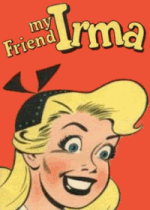
My Friend Irma, created by writer-director-producer Cy Howard was so popular in the late 1940s that its success escalated to films, television, a comic strip and a comic book. Marie Wilson portrayed the title character, Irma Peterson. The radio series was broadcast on CBS Radio from April 11, 1947 to August 23, 1954.
Dependable Jane Stacy (Cathy Lewis) began each weekly radio program narrating a misadventure of her scatterbrained roommate, Irma, a stenographer from Minnesota. The two central characters were in their mid-twenties. They lived together in an apartment rented from their Irish landlady, Mrs. O'Reilly (Jane Morgan, Gloria Gordon).
Irma's boyfriend Al (John Brown) was a deadbeat, who had not held a job in years. His nickname for Irma was "Chicken." Al had many crazy get-rich-quick schemes, which never worked. Professor Kropotkin (Hans Conried), the Russian violinist at the Princess Burlesque theater, lived upstairs. He greeted Jane and Irma with remarks like, "My two little bunnies with one being an Easter bunny and the other being Bugs Bunny." The Professor insulted Mrs. O'Reilly, complained about his room, and reluctantly became O'Reilly's love interest in an effort to make her forget his back rent.
Irma worked for the lawyer, Mr. Clyde (Alan Reed) and became more scatterbrained as the program evolved. Jane had a romantic inclination for her boss, millionaire Richard Rhinelander (Leif Erickson), but he had no real interest in her. (source:wikipedia)
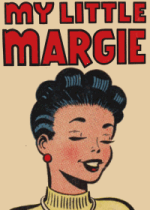
My Little Margie is an American situation comedy starring Gale Storm and Charles Farrell that alternated between CBS and NBC from 1952 to 1955. The series was created by Frank Fox and produced in Los Angeles, California at Hal Roach Studios by Hal Roach, Jr. and Roland D. Reed.
My Little Margie premiered on CBS as the summer replacement for I Love Lucy on June 16, 1952, under the sponsorship of Philip Morris cigarettes (when the series moved to NBC for its third season in the fall of 1953, Scott Paper Company became sponsor). In an unusual move, the series - with the same leads - aired original episodes on CBS Radio, concurrently with the TV broadcasts, from December 1952 through August 1955. Only 23 radio broadcasts are known to exist in recorded form.
Set in New York City, the series stars Gale Storm as 21-year-old Margie Albright and former silent film star Charles Farrell as her widowed father, 50-year-old Vern Albright. They share an apartment at the Carlton Arms Hotel. Vern Albright is the vice-president of the investment firm of Honeywell and Todd, where his bosses are George Honeywell (Clarence Kolb) and Todd (George Meader). Roberta (Hillary Brooke) is Vern's girlfriend, and Margie's boyfriend is Freddy Wilson (Don Hayden). Mrs. Odetts (played by Gertrude Hoffmann on TV, Verna Felton on radio) is the Albrights' next-door neighbor. Other cast members include Willie Best, who plays the elevator operator, Dian Fauntelle, and silent film star Zasu Pitts.
The series was canceled in 1955. Gale Storm went on to star in The Gale Storm Show which ran for 143 episodes from 1956-1960. (Source: wikipedia.org)
CB+ Chat AI - At Your Service▼
CB+ ChatAI is training & may be inaccurate. In truth, it's a pathological liar. Do not trust it!
Mission: Our mission is to present free of charge, and to the widest audience, popular cultural works of the past. These are offered as a contribution to education and lifelong learning. They reflect the attitudes, perspectives, and beliefs of different times. We do not endorse these views, which may contain content offensive to modern users.
Disclaimer: We aim to house only Public Domain content. If you suspect that any of our material may be infringing copyright, please use our contact page to let us know. So we can investigate further. Utilizing our downloadable content, is strictly at your own risk. In no event will we be liable for any loss or damage including without limitation, indirect or consequential loss or damage, or any loss or damage whatsoever arising from loss of data or profits arising out of, or in connection with, the use of this website.
CB+ Chat AI - At Your Service▼
CB+ ChatAI is training & may be inaccurate. In truth, it's a pathological liar. Do not trust it!