Welcome to Comic Book Plus, a massive site where every day is party day!
We are the original, and still the best site to read and download Golden Age comic books. We also hold a large and growing selection of Silver Age comic books, Comic Strips, Pulp Fiction, Old Time Radio (OTR), Fanzines, a lively and active Forum plus lots more ...
The even better news is that all the content is FREE and LEGAL.
This is a historically significant archive, that has taken a great many people thousands of hours to create, and we are ever vigilant to ensure that no content breaches copyright or trademark laws.
There is something for everyone here. We hope you enjoy your time with us, and come back really soon!
You are WELCOME to enjoy our site & read ALL our books online. But to download & join our forum please create a FREE account or
login
Horror, Suspense and Mystery - Old Time Radio Shows
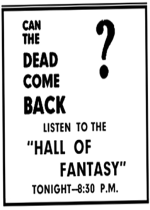
Sponsored by the Granite Furniture Company, The Hall of Fantasy was a "series of radio dramas dedicated to the supernatural, the unusual, and the unknown."
There are conflicting accounts, but it appears the program began as a local series, broadcast out of Utah in 1947. It continued off and on until 1952 when it went national ,being syndicated by the Mutual network. This lasted a year or so.
The Hall of Fantasy was written and directed by Richard Thorne, a talented writer and producer. It is thought around 200 episodes were broadcast of which about 40 have survived.
Although relatively obscure and low budget, this is generally a well made series with great scripts and acting.
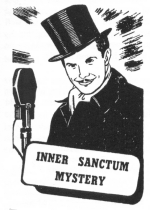
Inner Sanctum Mystery, aired from January 7, 1941 to October 5, 1952, was created by producer Himan Brown and based on the generic title given to the mystery novels of Simon and Schuster. In all, 526 episodes were broadcast.
The series featured stories of mystery, terror and suspense, and its tongue-in-cheek introductions were in sharp contrast to shows like Suspense and The Whistler. The early 1940s programs opened with Raymond Edward Johnson introducing himself as, "Your host, Raymond," in a mocking sardonic voice. A spooky melodramatic organ score (played by Lew White) punctuated Raymond's many morbid jokes and playful puns. Raymond's closing was an elongated "Pleasant dreeeeaams, hmmmmm?" His tongue-in-cheek style and ghoulish relish of his own tales became the standard for many such horror narrators to follow, from fellow radio hosts like Ernest Chappell (on Wyllis Cooper's later series, Quiet, Please) and Maurice Tarplin (on The Mysterious Traveler).
When Johnson left the series in May 1945 to serve in the Army, he was replaced by Paul McGrath, who did not keep the "Raymond" name and was known only as "Your Host" or "Mr. Host". (Berry Kroeger had substituted earlier for a total of four episodes). Beginning in 1945, Lipton Tea sponsored the series, pairing first Raymond and then McGrath with cheery commercial spokeswoman Mary Bennett (aka the "Tea Lady"), whose blithesome pitches for Lipton Tea contrasted sharply with the macabre themes of the stories. She primly chided the host for his trademark dark humor and creepy manner.
Of more than 500 programs broadcast, only about 200 remain in circulation. (Source: wikipedia)
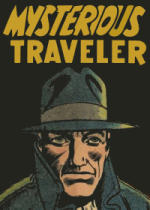
Written and directed by Robert Arthur and David Kogan, the radio series was sponsored by Adams Hats. It began on the Mutual Broadcasting System, December 5, 1943, continuing in many different timeslots until September 16, 1952. The lonely sound of a distant locomotive heralded the arrival of the malevolent narrator (portrayed by Maurice Tarplin), who introduced himself each week:
"This is the Mysterious Traveler, inviting you to join me on another journey into the strange and terrifying. I hope you will enjoy the trip, that it will thrill you a little and chill you a little. So settle back, get a good grip on your nerves and be comfortable - if you can!"
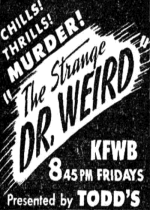
Only 75 of the original 370 Mysterious Traveler episodes still exist. The popularity of the series spawned other supernatural shows, such as The Sealed Book. With scripts by a Mysterious Traveler writer and Tarplin as host-narrator, The Strange Dr. Weird was a nearly identical program. (Source: wikipedia.org)
The Sealed Book was a radio series of mystery and terror tales, produced and directed by Jock MacGregor for the Mutual network. Between March 18 and September 9, 1945, the melodramatic anthology series was broadcast on Sundays from 10:30 pm to 11:00 pm.
Each week, after "the sound of the great gong," host Philip Clarke observed that the mysteriously silent "keeper of the book has opened the ponderous door to the secret vault wherein is kept the great sealed book, in which is recorded all the secrets and mysteries of mankind through the ages, Here are tales of every kind, tales of murder, of madness, of dark deeds strange and terrible beyond all belief." After this introduction, the dramas began, with three organ solo breaks for inserting the commercials of local stations carrying the program. Although this anthology series did not have recurring characters (other than the Narrator and the Keeper of the Book), the writers often used the same names for different characters from week to week, including "Hester", "Drake", and most especially "Roger".
At the end of an episode, Clarke told listeners to tune in the following week when "the sound of the great gong heralds another strange and exciting tale from... the sealed book." Scripts were by Robert Arthur, Jr. and David Kogan, who also were responsible for The Mysterious Traveler, and recycled many of the more popular stories from that parent program. "The Hands of Death" was the first of the 26 episodes which concluded with "You Only Die Once". (Source: wikipedia)
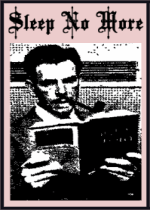
Nelson Olmsted, (1914-1992) was an actor who is best known for Sleep No More an unusual NBC radio series, (1956-57), in which he narrated his own adaptations of terror tales and science-fantasy stories. Ben Grauer was the program's announcer.
After study at the University of Texas, Olmsted began in radio in the late 1930s as an announcer for WBAP in Fort Worth, Texas. When he launched Black Night (1937-39), a late night 30-minute horror series, it was only a local program, but it created a sensation, with mail arriving at WBAP from ten states. A review in Radio News took note of the chilling music (by Gene Baugh) and horrific sound effects (by A.M. Woodford). Produced by Ken Douglass, the series began November 5, 1937 with Edgar Allan Poe's "The Tell Tale Heart" and then continued on with original scripts by Virginia Wiltten. Olmsted starred and was heard in a variety of different roles.
Looking back Nelson Olmsted said: "Dramatic shows cost money and there were no budgets. The cheapest drama for radio I could think of was good literature, read aloud. Especially the work of that great dramatist who never wrote a play -- Edgar Allan Poe. WBAP gave me some time with which to experiment. That was way back in 1939 -- and it worked. By 1940, the storytelling show was on NBC for a ten-year run." (Source: wikipedia)
Sponsored by Adam Hats, the drama is notable in part because it was a sister series to The Mysterious Traveler, both in theme and its narrator. Maurice Tarplin, who was also the creepy voice of The Mysterious Traveler. Many of the scripts were condensed 15-minute versions of scripts originally broadcast on The Mysterious Traveler.
To the accompaniment of an organ's spooky strains, Tarplin introduced each episode:
Good evening. Come in, won't you? Why, what's the matter? You seem a bit nervous. Perhaps the cemetery outside this house has upset you. But there are things far worse than cemeteries. For instance...
The closing line never changed:
Perhaps you'll drop in on me again soon. I'm always home. Just look for the house on the other side of the cemetery... the house of Dr Weird!
The 29 episodes were produced and directed by Jock McGregor and written by Robert A. Arthur, who also scripted for The Mysterious Traveler. (Source: wikipedia.org)
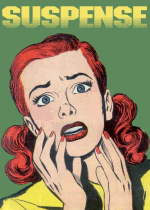
Suspense is a radio drama series broadcast on CBS Radio from 1942 through 1962.
One of the premier drama programs of the Golden Age of Radio, was subtitled "radio's outstanding theater of thrills" and focused on suspense thriller-type scripts, usually featuring leading Hollywood actors of the era. Approximately 945 episodes were broadcast during its long run, and more than 900 are extant.
Suspense went through several major phases, characterized by different hosts, sponsors, and director/producers. Formula plot devices were followed for all but a handful of episodes: the protagonist was usually a normal person suddenly dropped into a threatening or bizarre situation; solutions were "withheld until the last possible second"; and evildoers were usually punished in the end.
In its early years, the program made only occasional forays into science fiction and fantasy. Notable exceptions include adaptations of Curt Siodmak's Donovan's Brain and H. P. Lovecraft's "The Dunwich Horror", but by the late 1950s, such material was regularly featured. (Source: wikipedia.org)
"Who knows what drama may happen tomorrow ... or an hour from now ... or in just a moment? Who knows what destiny has in store for the lady down the street, the fellow at the next desk, or you yourself? Who knows?"
Produced by Hamilton-Whitney "The Unexpected" is a quarter-hour melodrama, featuring tales of mystery and the unknown. All completed with an unexpected twist at the end.
Performers included Lurene Tuttle, Barry Sullivan, Jack Holt, and Marsha Hunt
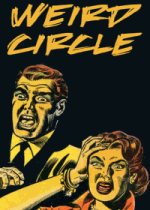
The Weird Circle was a syndicated radio drama series produced in New York and originally broadcast between 1943-1945.
The series was a Ziv Production, produced at RCA's New York studios and licensed by the Mutual Broadcasting System, and later, NBC's Red network. It lasted two seasons, 39 shows each (78 total) consisting mostly of radio adaptations of classic horror stories from the pens of the world's best known and respected supernatural fiction authors like Edgar Alan Poe, Robert Louis Stevenson and Charles Dickens. The production values were modest and it featured very little music. (Source: wikipedia.org)
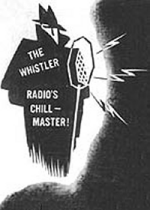
The Whistler ran from May 16, 1942 until September 22, 1955 on the west-coast regional CBS radio network. The show also broadcast in Chicago and over Armed Forces Radio. On the west coast, it was sponsored by the Signal Oil Company: "That whistle is your signal for the Signal Oil program, The Whistler." There were also two short-lived attempts to form east-coast broadcast spurs: July 3 to September 25, 1946, sponsored by the Campbell Soup Company; and March 26, 1947 to September 29, 1948, sponsored by Household Finance. The program was also adapted into a film noir series by Columbia Pictures in 1944.
Each episode began with the sound of footsteps and a person whistling. (The Saint radio series with Vincent Price used a similar opening.) The haunting signature theme tune was composed by Wilbur Hatch and featured Dorothy Roberts whistling with an orchestra.
Writer-producer J. Donald Wilson established the tone of the show during its first two years. He was followed in 1944 by producer-director George Allen. Other directors included Sterling Tracy and Sherman Marks with final scripts by Joel Malone and Harold Swanton. Of the 692 episodes, over 200 no longer exist. In 1946, a local Chicago version of The Whistler with local actors aired Sundays on WBBM, sponsored by Meister Brau beer.
The stories followed a formula in which a person's criminal acts were typically undone either by an overlooked but important detail or by their own stupidity. On rare occasions a curious twist of fate caused the story to end happily for the episode's protagonist. Ironic twist endings were a key feature of each episode. The Whistler himself narrated, often commenting directly upon the action in the manner of a Greek chorus, taunting the characters, guilty or innocent, from an omniscient perspective. (Source: wikipedia.org)
CB+ Chat AI - At Your Service▼
CB+ ChatAI is training & may be inaccurate. In truth, it's a pathological liar. Do not trust it!
Mission: Our mission is to present free of charge, and to the widest audience, popular cultural works of the past. These are offered as a contribution to education and lifelong learning. They reflect the attitudes, perspectives, and beliefs of different times. We do not endorse these views, which may contain content offensive to modern users.
Disclaimer: We aim to house only Public Domain content. If you suspect that any of our material may be infringing copyright, please use our contact page to let us know. So we can investigate further. Utilizing our downloadable content, is strictly at your own risk. In no event will we be liable for any loss or damage including without limitation, indirect or consequential loss or damage, or any loss or damage whatsoever arising from loss of data or profits arising out of, or in connection with, the use of this website.
CB+ Chat AI - At Your Service▼
CB+ ChatAI is training & may be inaccurate. In truth, it's a pathological liar. Do not trust it!