Welcome to Comic Book Plus, a massive site where every day is party day!
We are the original, and still the best site to read and download Golden Age comic books. We also hold a large and growing selection of Silver Age comic books, Comic Strips, Pulp Fiction, Old Time Radio (OTR), Fanzines, a lively and active Forum plus lots more ...
The even better news is that all the content is FREE and LEGAL.
This is a historically significant archive, that has taken a great many people thousands of hours to create, and we are ever vigilant to ensure that no content breaches copyright or trademark laws.
There is something for everyone here. We hope you enjoy your time with us, and come back really soon!
You are WELCOME to enjoy our site & read ALL our books online. But to download & join our forum please create a FREE account or
login
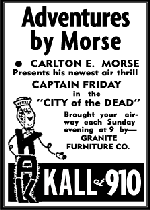
Adventures by Morse is a syndicated adventure series produced, written and directed by Carlton E. Morse in the mid-1940s, shortly after NBC canceled his I Love a Mystery series. Morse produced 52 episodes of the program, each 30 minutes long.
Captain Bart Friday was a globe-trotting San Francisco-based private investigator, portrayed during the series by Elliott Lewis, David Ellis and Russell Thorson. Friday's sidekick from Texas, Skip Turner, was played mostly by Jack Edwards and occasionally by Barton Yarborough.
The tales covered such areas as espionage, kidnapping and murder, along with secret Nazi bases, snake worshipers and voodoo.
The series was presented in 13-episode blocks (each containing two stories), with each ten-chapter story ending with a teaser for the following three-chapter story. The City of the Dead and A Coffin for the Lady are mentioned in the promotional recordings as the first and second story respectively. (source: wikipedia)
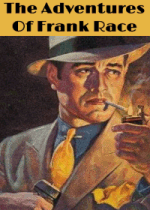
The Adventures of Frank Race was an American radio adventure serial syndicated by Bruce Eells Productions. The 30-minute program's first East Coast broadcast was 1949, and the show ran 43 episodes. Because it was syndicated, it aired on different stations on different days. For instance, in New York City, the first episode ran on WINS on April 9, 1949. It "began running in some markets May 1, 1949. The series was broadcast on the West Coast from 1951 - 1952.
Each episode opened with a one-minute organ theme and then the following from announcer Art Gilmore:
"The war changed many things; the face of the earth and the people on it. Before the war, Frank Race worked as an attorney, but he traded his law books for the cloak-and-dagger of the OSS. And when it was over, his former life was over, too... adventure had become his business!"
Frank Race mainly investigated international insurance scams around the globe in various exotic locations, making him something of a cross between James Bond and Johnny Dollar. After Tom Collins played the title role for the first 22 episodes, Paul Dubov took over the lead role. Tony Barrett portrayed Race's sidekick, Mark Donovan. Other actors included Jack Kruschen, Wilms Herbert, Lillian Buyeff, Frank Lovejoy and Harry Lang.
The series was written and directed by Joel Murcott and Buckley Angel. Ivan Ditmars provided the background organ music. (Source: wikipedia.org)
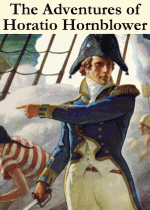
Horatio Hornblower is a fictional Napoleonic Wars era Royal Navy officer who is the protagonist of a series of novels by C. S. Forester. He was later the subject of films and radio and television programs.
The original Hornblower tales began with the 1937 novel The Happy Return (U.S. title Beat to Quarters) with the appearance of a junior Royal Navy captain on independent duty on a secret mission to Central America. Later stories filled out his earlier years, starting with an unpromising beginning as a seasick midshipman. As the Napoleonic Wars progress, he gains promotion steadily as a result of his skill and daring, despite his initial poverty and lack of influential friends. After surviving many adventures in a wide variety of locales, he rises to the pinnacle of his profession, promoted to Admiral of the Fleet, knighted as a Knight Grand Cross of the Order of the Bath (GCB), and named the 1st Baron Hornblower.
Michael Redgrave played Hornblower in a radio series of the same name between 1952 and 1953, later rebroadcast over Mutual in the United States syndicated via Towers of London. (Source: wikipedia.org)
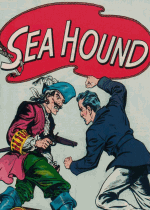
Adventures of the Sea Hound was a popular radio show that ran on the Blue Network from 1942 to 1945, Mutual from 1946-47, and ABC in 1948. Between 1942 and 1945, it was produced on behalf of Nelson A. Rockefeller's Office of Inter-American Affairs (1940-46) and was part of a national program to strengthen inter-American relations.
Broadcast five times a week, the show featured Captain Silver and his sidekick Jerry hunting Nazi spies throughout the hemisphere. Every episode took place in a different Latin American country. Listeners were encouraged to write to NBC to request Captain Silver's Sea Chart - a colorful map of the Americas that informed on the most important products and carried on its border pictures of outstanding heroes and flags of all the Latin America republics. Some 200,000 of such maps were sent out.
The show spawned a short lived comic book and the 1947 Columbia serial, The Sea Hound, starring Buster Crabbe. (source: wikipedia)
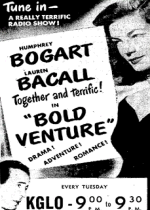
Bold Venture was a syndicated radio series starring Humphrey Bogart and Lauren Bacall that aired from 1951 to 1952. Morton Fine and David Friedkin scripted the taped series for Bogart's Santana Productions.
Salty seadog Slate Shannon (Bogart) owns a Cuban hotel, Shannon's Place, sheltering an assortment of treasure hunters, revolutionaries, and other shady characters. With his sidekick and ward, the sultry Sailor Duval (Bacall), tagging along, he encounters modern-day pirates and other tough situations while navigating the waters around Havana. Aboard his boat, the Bold Venture, Slate and Sailor experience "adventure, intrigue, mystery and romance in the sultry settings of tropical Havana and the mysterious islands of the Caribbean."
Calypso singer King Moses (Jester Hairston) provided musical bridges by threading plot situations into the lyrics of his songs. Music for the series was by David Rose.
The series combined elements of a number of past Bogart/Bacall film collaborations, most notably To Have and Have Not which also cast Bogart as a boat owner in the Caribbean who reluctantly becomes involved in intrigue while romancing Bacall. The relationship between Shannon and King Moses, and his ownership of an inn, is strongly reminiscent of the dynamic between Rick Blaine and Sam in Casablanca.
Production
Beginning in March 1951, the Frederic W. Ziv Company syndicated 78 episodes via electrical transcription. Some sources have claimed that the 78 episodes include reruns, and that there were only around 30 episodes but more than 50 shows have now come to light. Heard on 423 stations, the 30-minute series earned $5,000 weekly for Bogart and Bacall.
57 episodes are now known to exist, some are known by more than one title which can make it appear that there are more. (source: wikipedia)
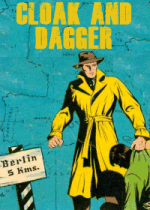
Cloak and Dagger opened over the NBC network on May 7, 1950. It had a short run through the Summer on Sundays, changing to Fridays after its Summer run. The last show aired October 22, 1950.
The series told fictional stories of OSS agents during World War II who took dangerous missions behind enemy lines, knowing they may never return alive.
The series was based on the 1946 book "Cloak and Dagger: The Secret Story of the OSS" by Corey Ford and Alastair MacBain. It was a tense half hour of patriots and traitors, of triumph, tragedy and failure. The stories did not always end in success -- sometimes, the hero/agent gave up his life. There were 22 episodes, broadcast in 1950.
The theme music was either identical or very similar to that used by Tales of the Texas Rangers.
Sherman Marks directed. The cast consisted of The Hungarian Giant, played by Raymond Edward Johnson, and Impy the Midget, played by Gilbert Mack. (source: Old Time Radio Researchers Group)
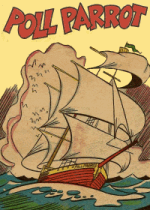
In 1922, businessman Paul Parrot sold his shoe business "Poll Parrot Shoes" to the International Shoe Company, which was already selling Red Goose and Weatherbird shoes. The shoes were designed for children and so sponsoring a children's radio show seemed like a good idea. In 1937, they launched a syndicated children's serial named "Cruise of the Poll Parrot". The show was sold in thirteen segment blocks, and three complete blocks exist today. The shows exponentially boosted shoe sales, helping International compete against the leader in children's shoes: Buster Brown.
The main character for the show was a 24 year old man from St. Louis, Missouri, named Marvin Miller. This was some of his first radio work. He was the voice for the main character, Captain Roy Dalton, the Master of the ship Poll Parrot, and also the voice of the parrot that was the pet of the Captain. Marvin Miller went on to work on hundreds of other radio shows, mostly as an announcer. He acted in a number of films, most notably in 1947 starring with Humphrey Bogart in "Dead Reckoning". Miller played a crooked gambler's sadistic henchman named Krause. He became most famous as Michael Anthony, the man who handed out the million dollar checks in the 1950s TV series, "The Millionaire". Miller died in Los Angeles of a heart attack in 1984 at the age of 71.
The Cruise of the Poll Parrot takes place in 1858 in New Bedford, Massachusetts, center of the United States whaling industry. Besides Captain Roy Dalton, the cast included Ezra Grange, owner of the Poll Parrot, Ezra's little sister Sue, and her friend Johnny Robbins. Other characters on the show were first mate George Wainwright, a one legged sailor named Old Dickson, a muteness crew member named Red Mahooley, ship keeper Breckenridge, and El Testi who was an agent for another shipping company. (Source: Old Time Radio Researchers Group)
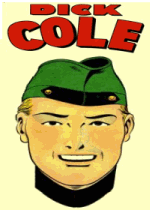
The Adventures of Dick Cole was a 1942 juvenile adventure radio series based on a comic book character published by Novelty Press, and later, Star Publications. Created in 1940 by cartoonist Bob Davis (The Chameleon), Dick Cole is a heroic cadet at the fictional Farr Military Academy. The character was introduced in the "Origin of Dick Cole," in the first issue of Novelty Press' Blue Bolt Comics (June 1940).
In 1942, the comic book series was adapted into a 30-minute radio program which followed the adventures of Cole (Leon Janney) at the Farr Military Academy. When Cole wasn't winning football games, he tracked evildoers with an assist from his Academy pals Simba and Ted. The announcer was Paul Luther. Lew White provided the background music.
Billed as "America's Number One School Star," Dick Cole was a popular backup feature in Novelty Press' Blue Bolt (and later 4 Most), with regular stories about the young hero appearing until 1949. The character got his own book with five issues of Dick Cole (Novelty Press/Star Publications, 1948-1949), illustrated by L.B. Cole, Joe Certa, Jim Wilcox, Al Fagaly, Jack Hearne, and others. L.B. Cole continued the title for five more issues at Star Publications in 1949-1950. (Many of the stories published in the Star issues were reprints from Blue Bolt and another Novelty Press title, Target Comics.) (Source: wikipedia.org)
Frank Merriwell first appeared in a series of novels and short stories by Gilbert Patten, who wrote under the pseudonym Burt L. Standish. The model for all later American juvenile sports fiction, Merriwell excelled at football, baseball, basketball, crew and track at Yale while solving mysteries and righting wrongs. He played with great strength and received traumatic blows without injury.
The Adventures of Frank Merriwell first ran on NBC radio from March 26 to June 22, 1934 as a 15-minute serial airing three times a week at 5:30pm. Sponsored by Dr. West's Toothpaste, this program starred Donald Briggs in the title role. Harlow Wilcox was the announcer.
After a 12-year gap, the series returned October 5, 1946 as a 30-minute Saturday morning show on NBC, continuing until June 4, 1949. Lawson Zerbe starred as Merriwell, Jean Gillespie and Elaine Rostas as Inza Burrage, Harold Studer as Bart Hodge and Patricia Hosley as Elsie Belwood. Announcers were Mel Brandt and Harlow Wilcox, and the Paul Taubman Orchestra supplied the background music. (Source: wikipedia.org)
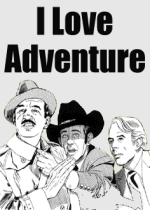
A short lived series written by Carlton E. Morse. In 1948, four years after "I Love a Mystery" ended , Jack, Reggie, and Doc returned with a title change to "I Love Adventure", broadcast on ABC from April 25 to July 18, 1948. It followed the post-war adventures of the trio who worked for the Twenty-One Old Men of 10 Gramercy Park in London, an extra-governmental organization of some power. The series ran for 13 episodes.
A year later, I Love a Mystery was revived on the Mutual Broadcasting System, and the production relocated from Hollywood to New York. This series, which was sustaining, began October 3, 1949, and continued until December 26, 1952, with 15-minute episodes heard weeknights at 7 p.m. during 1949-1950 and then 10:15 p.m. from 1950 to 1952. The Mutual series recreated the original scripts written by Morse for the earlier NBC series. (source: wikipedia)
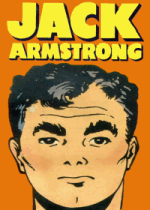
Jack Armstrong, the All-American Boy was a radio adventure series which maintained its popularity from 1933 to 1951. The program originated at WBBM in Chicago on July 31, 1933, and was later carried on CBS, then NBC and finally ABC. It was created by General Mills, a pioneer in the development of unique and compelling advertising under the stewardship of Vice-president of Advertising, Samuel Chester Gale. Gale later served as President of the Ad Council. Intending to promote breakfast cereal Wheaties, Gale developed the character of Jack Armstrong as a fictitious "everyboy" whom listeners would emulate: If Jack ate Wheaties, boys across the nation would, too. Early popularity led to commissioning of a radio serial broadcast.
There was a real Jack Armstrong, a member of Sam Gale's college fraternity, Phi Sigma Kappa at the University of Minnesota. Gale was impressed by both the red-blooded name and the "wholesome nature" of the young man so he incorporated it as the name of his new invented spokesman. Another creation of Sam Gale's fertile mind was the iconic Betty Crocker.
The storylines centered around the globe-trotting adventures of Armstrong (played by Jim Ameche until 1938 and later portrayed by Michael Rye), a popular athlete at Hudson High School, his friends Billy Fairfield and Billy's sister Betty, and their Uncle Jim, James Fairfield, an industrialist. Frequently, Uncle Jim Fairfield would have to visit an exotic part of the world in connection with his business, and he would take Jack Armstrong and the Fairfield siblings along with him. The show was created by writer Robert Hardy Andrews. Sponsored throughout its long run by Wheaties, the program was renamed Armstrong of the SBI when Jack graduated from high school and became a government agent in the final season, when it shifted from a 15-minute serial to a half-hour complete story format. (Source: wikipedia.org)
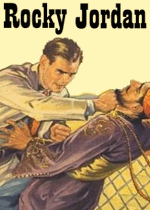
Rocky Jordan was a radio series about an American restaurateur in Cairo who each week became involved in some kind of mystery or adventure. The show was broadcast on CBS from October 31, 1948 to September 10, 1950. and then again from June 27, 1951 to August 22, 1951. The character of Rocky Jordan had been introduced to listeners in a similar show called A Man Named Jordan that was broadcast in 1945 but set in Istanbul rather than Cairo.
The two lead roles were those of Rocky Jordan and Captain Sam Sabaaya of the Cairo Police. For most of the show's history Jordan was played by veteran radio actor Jack Moyles, but he was replaced by a movie star, George Raft, for the brief 1951 run.
Jay Novello played Sabaaya throughout the entire series. Other roles were played by members of Hollywood's Radio Row, and the announcer was Larry Thor. (Source: wikipedia.org)
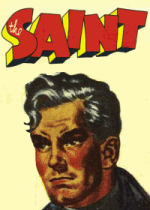
The Saint, a modern day Robin Hood was created by author Leslie Charteris and as the original Radio program's introduction said, he was: "known to millions from books, magazines, and motion pictures." Several versions of the program appeared on different networks.
The Saint began its life on radio in January 1945. Edgar Barrier starred, and Bromo-Seltzer was the sponsor. This version ended March 31, 1945. The second iteration of The Saint on radio was a summer replacement for the Jack Carson Show on CBS, the program went off when its summer run ended September 12, 1945. Brian Aherne starred, and Campbell Soups was the sponsor. The show's third version, which began July 9, 1947, was limited to CBS' West Coast network. It ended June 30, 1948. The sponsor was Lever Brothers. Vincent Price starred in this version and in most of the show's episodes in the two versions that followed.
After a year's hiatus, The Saint returned to radio July 10, 1949 - this time on Mutual. The show lasted through May 28, 1950. The program's final run began June 11, 1950, as a summer replacement for The Phil Harris-Alice Faye Show. The Saint was back on its original network, NBC, for this version, which ended October 14, 1951. The show lasted longer in this version than in any other.
The title role was also played briefly by Tom Conway (whose brother, George Sanders, had played Simon Templar in several films), and Barry Sullivan. Louise Arthur played Patricia Holm, Templar's assistant. Lawrence Dobkin played Louie, the cab driver. John Brown played Inspector Fernack, and Ken Christy played Hoppy, Templar's sidekick. (Source: wikipedia.org)
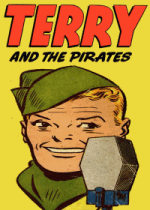
Terry and the Pirates radio serial was adapted from Milton Caniff's 1934 comic strip. With storylines of action, high adventure and foreign intrigue, the series entralled listeners from 1937 through 1948.
The central character, Terry Lee, was portrayed at various times by Jackie Kelk, Cliff Carpenter, Owen Jordan, and Bill Fein. Terry's buddy Pat Ryan was played by Bud Collyer, Warner Anderson, Bob Griffin, and Larry Alexander. Others characters were Flip Corkin (Ted de Corsia), Elita (Gerta Rozan), Burma (Frances Chaney), Hotshot Charlie (Cameron Andrews) and Connie the coolie (Cliff Norton, John Gibson, Peter Donald). The main villain was the Dragon Lady (Agnes Moorehead, Adelaide Klein, Marion Sweet, Mina Reaume).
When the late afternoon series began, it was heard at 5:15pm, three times a week, sponsored by Dari-Rich, airing on NBC Red Network from November 1, 1937 to June 1, 1938. It switched to NBC Blue Network on September 26, 1938, continuing until March 22, 1939. Absent from the airwaves for over two years, it returned shortly before the Attack on Pearl Harbor, heard in the Midwestern United States on the Chicago Tribune's WGN. That series, sponsored by Libby's, aired five days a week from October 16, 1941 to May 29, 1942.
With increasing popularity during World War II, the show next took off at a fast pace on Blue Network, airing daily for 15 minutes on weekday afternoons beginning February 1, 1943. The Quaker Puffed Wheat and Puffed Rice "shot from guns" commercials often had a patriotic pitch. Douglas Browning was the announcer during the mid-1940s. After 1945, with no wartime villains for Terry and his pals to fight, ratings began to drop in the post-WWII period until the final episode on June 30, 1948. (Source: wikipedia.org)
CB+ Chat AI - At Your Service▼
CB+ ChatAI is training & may be inaccurate. In truth, it's a pathological liar. Do not trust it!
Mission: Our mission is to present free of charge, and to the widest audience, popular cultural works of the past. These are offered as a contribution to education and lifelong learning. They reflect the attitudes, perspectives, and beliefs of different times. We do not endorse these views, which may contain content offensive to modern users.
Disclaimer: We aim to house only Public Domain content. If you suspect that any of our material may be infringing copyright, please use our contact page to let us know. So we can investigate further. Utilizing our downloadable content, is strictly at your own risk. In no event will we be liable for any loss or damage including without limitation, indirect or consequential loss or damage, or any loss or damage whatsoever arising from loss of data or profits arising out of, or in connection with, the use of this website.
CB+ Chat AI - At Your Service▼
CB+ ChatAI is training & may be inaccurate. In truth, it's a pathological liar. Do not trust it!