| Comments |
| |
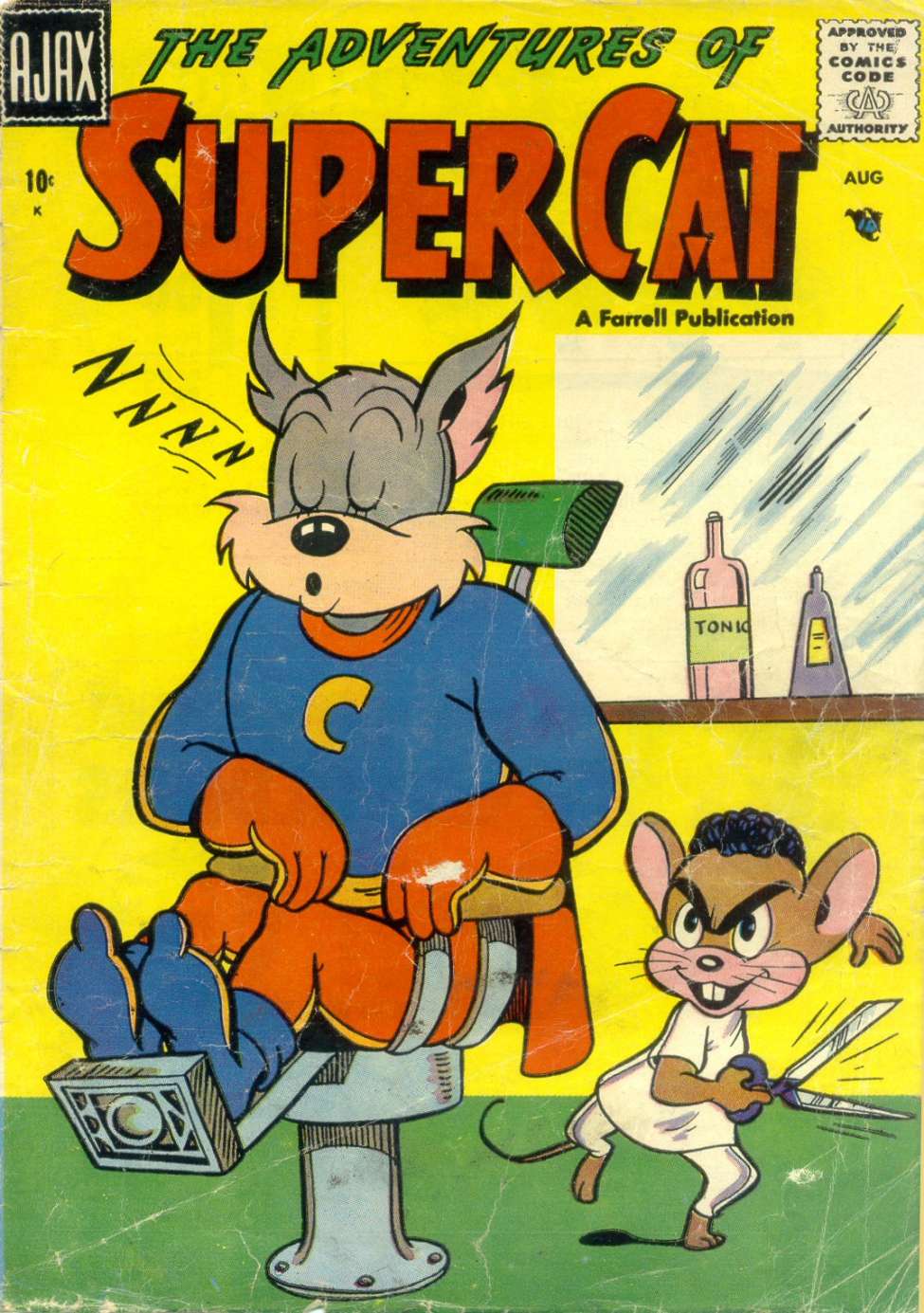
| Some oddities here. The character is Super Cat, but the cover artist used the original Cosmo Cat "C" chest symbol, rather than the Super Cat "SC" symbol. Another oddity is that, except for the cover, Super Cat does not appear in the comic at all. And an oddity of the scan is that the middle pages of the Spunky story have been put before the actual first story, which is Neddy. |
|
| Yes, Publisher, Robert Farrell, who had run Fox Features for Victor Fox when the latter was busy in court, fighting lawsuits, also bought the old Fox "Cosmo Cat" artwork, and rights to the character, to provide Fox with some money to pay his lawyers, in 1951. Back in 1949, Farrell, handling Fox's comic book business, leased "Cosmo Cat" and other Fox comics properties to L.B. Cole's Star Publishing, which were combined with Cole's Novelty Funny Animals stories in their new "Frisky Animals" title, successor of their "Frisky Fables". And Cosmo Cat's name in that series was changed to Super Cat, and he appeared on that title's front covers, starting with Issue #54, and the title was changed to Frisky Animals Presents Super Cat", with Super Cat in much bigger letters. For The last 2 issues, in 1954, the series' title was changed to just "Super Cat". When Star ceased their operations in mid 1954, Cosmo/Super Cat's rights reverted to Farrell. He decided in 1957, to start several new Funny Animal/young children's series, most of which he issued under his Ajax Comics banner, issuing manly reprints of Novelty/Star's Frisky Fables/Animals and Fox Features children's comics, but also "spicing them up" a bit with a new clone of "Casper, The Friendly Ghost" "Spunky", and a revival of "Super Cat" using commissioned new artwork. Unfortunately, the new artwork, other than the new comic book front covers of "Super Cat" wasn't ready by printing time for the first 2 issues. So they couldn't have Super Cat stories. Also, unfortunately, the series' sales were terrible, so it only lasted 2 more issues, which DID include new Super Cat stories, but the stories' plots and writing were really poor quality, and the artwork was also very weak. The "Spunky"/"Mighty Ghost" series fared a little better, but ended after only 6 issues and 2 title changes. There were several Casper clones on the comics shelves during the late 1950s and early '60s. |
|
| That's very interesting, Robb. I had put the following statements into the GCD record for the Cosmo Cat feature (https:www.comics.org/feature/32677/):
"In 1952 & 1953 Star Publications reprinted Cosmo Cat stories crediting the original creator, Pat Adams. In 1953 they changed the name of the character and feature in the reprints to Super Cat, presumably because they were not authorized to publish Cosmo Cat. They removed Adams's credits, and the artist's signatures."
But from what you say my speculation was incorrect. I can see them changing the name to possibly increase sales, even though the stories were still reprints of the Cosmo Cat stories. But I don't see why they would need to remove artist credits and signatures if they still had the right to publish them.
Do you think it would be correct to change that to "possibly because they were no longer authorized to publish Cosmo Cat" ? Or did Star always have the rights until they ceased publication? |
|
| I can't believe that, somehow Cole's Star Publishing DIDN'T have the legal rights to reprint "Cosmo Cat" stories, because they had leased the rights to reprint several Fox series, including "Blue Beetle", and various of their adventure and police/crime series, as well as their teen comedy series. They combined Fox stories together with Novelty stories with new Cole-drawn front covers to make the mostly reprint books appear to be new books, and they also hired Jay Disbrow to draw new Horror and Sci-Fi lead stories for his Horror and Action series mostly filled with Novelty and Fox reprints. Although no Dollar figures are available on the lease agreements between Star and Farrell, the scuttlebutt was that it wasn't a large amount of money, so Cole and Kramer could afford it. So, I doubt that they didn't own the rights. It was well documented that Farrell had bought those rights in a "disaster sell-off" by Victor Fox, as he was desperate for cash to pay his lawyers and had lost all his liquid assets, and was desperate to stay out of prison. Farrell had been Fox's right hand man in Fox Features daily operations. I can't imagine why the artist's signatures would have had to be removed, as they never received residuals for their work being reprinted. Once they got paid for their comic book story writing or artwork, it was the property of the publisher, and anyone who obtained those rights from the original publisher, or later owner. EVEN IF Farrell had not received possession of that artwork legally, the artist's or writers' names on the stories wouldn't endanger Farrell or Cole. But, in any case, it is well documented that Farrell HAD purchased those properties from Fox. The only thing I can think of that might be the reason for the name change and credit removal is that in mid 1953, Fox's copyright period ended, and had to be renewed, and neither Cole nor Farrell wanted to pay to extended it, and Cole wanted his books to all look like new material (thus his new covers -and new series titles, and new character names), and both Cole and Farrell thought that the writer name "Pat Adams" would give away their secret that these were really just "Cosmo Cat" reprints. But any kids who would remember seeing the name, "Pat Adams" on Cosmo Cat stories would be even more likely to remember the story was an old Cosmo Cat story. Also, I can believe that Robert Farrell would risk doing something shady, like copyright infringement, as he'd done questionable things like that in the past. But, L.B. Cole had a reputation for being a straight -shooter, and never done anything underhanded, as far as I remember. I don't believe that the agreement that the writer or artist had with their original publisher, that required the original publisher to have the artist's name on the story first page, is binding to a different publisher, who purchases its publishing rights. It was only in the original agreement between artist and that publisher. The original publisher is bound by that for any reprints HE issues. But when the comic book property is transferred to a new owner, I don't believe that agreement is in force. |
|
| | |