The radio western began as fast-paced afternoon programming for younger listeners before expanding into adult dramas that looked at the social landscape of the 19th-century frontier. For sound engineers, the genre required specific acoustic techniques to simulate outdoor environments, wind, and movement entirely within a studio.
The collection covers several production approaches:
Adult frontier dramas: Gunsmoke (1952–1961) changed the genre by focusing on the mundane and often violent realities of Dodge City. Similarly, Frontier Gentleman (1958) used an unusual perspective, following a British journalist reporting on the territories for the London Times.
Media crossovers: While most shows went from radio to television, Have Gun – Will Travel (1958–1960) did the opposite, adapting the television property into a standalone radio run starring John Dehner. The section also includes Hopalong Cassidy and The Cisco Kid, which drew from established pulp fiction and B-movies.
Early syndication: The listings feature early transcribed serials like Buck Jones in Hoofbeats (1936) alongside post-war independent productions like Frontier Town and Lightning Jim.
You are WELCOME to enjoy our site & read ALL our books online. But to download & join our forum please create a FREE account or
login
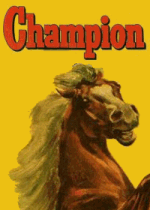
The Adventures of Champion is an American adventure serial radio drama directed by William Burch about screen cowboy Gene Autry's horse Champion. Each 15-minute episode was broadcast weekday afternoons on the Mutual Broadcasting System in 1949 and 1950.
The Western mystery tales focused on twelve year old Ricky West, who is raised in the wilderness by his adopted Uncle Sandy, and his German Shepherd named Rebel. Champion was depicted as a wild horse who let only Ricky ride him. While the series covered gold mines, rustlers, and Indian problems, the primary focus was on the faith and loyalty between a boy, a dog, and a horse.
The radio series was a spin-off from Gene Autry's Melody Ranch, a CBS radio network Sunday-afternoon program featuring the singing cowboy from 1940 to 1956. A television series called The Adventures of Champion aired for 26 episodes on CBS during the 1955-1956 season and starred Barry Curtis and Jim Bannon. (Source: wikipedia.org)
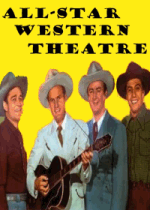
The All Star Western Theatre graced the airwaves in the mid-1940's and was made up of a variety of different shows. The shows delivered riotous laughs and down-to-earth humor that was a pleasant alternative to other heavier and intense programs. The music of these old radio shows was done by a group called "The Riders of the Purple Sage," and was fronted by Foy Willing.
Enjoy a rootin' tootin' hoe-down with the best of the West and download All Star Western Theatre today! Of the 78 episodes produced, 66 are in circulation today. So sit back, relax, and enjoy some well produced radio from the 40's. (Source: Old Time Radio Researchers Group)
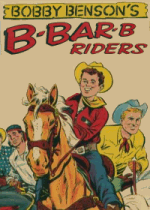
"Here they come! They're riding fast and they're riding hard! It's time for action and adventure in the modern West with Bobby Benson and the B-Bar-B Riders! And out in front, astride his golden palomino Amigo, it's the cowboy kid."
Well in fact Bobby Benson and the gang actually rode in two separate eras. Firstly in the very early days of juvenile radio (1932-36), and then post war (1949-55) when radio was on the wane and kids were huddling around the television.
The series was created by Herbert C. Rice of the Buffalo Broadcasting Corporation. Cereal producer the Hecker H-O were looking to sponsor a children's radio show and Bobby Benson was Rice's answer.
The show was a massive success with extra staff being hired to deal with the demand for premiums. When the show eventually folded in December 1936 it had aired over 700 episodes. Sadly nothing appears have survived from this first run.
In 1949, thirteen years after it finished, Rice, now a Vice President with the Mutual Network brought the show back. This second run featured a smaller cast, also the ranch was renamed "The B-Bar-B". It would last six years and clock up over 350 episodes, not too shabby for an encore!
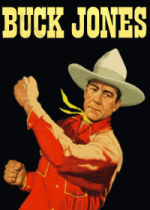
Buck Jones (December 12, 1891 - November 30, 1942) was an American motion picture star of the 1920s, 1930s, and 1940s, known for his work starring in many popular western movies. In his early film appearances, he was billed as Charles Jones.
Buck Jones was hired by Universal Pictures for $5 per day as a bit player and stuntman. He later worked for Canyon Pictures, then Fox Film Corporation, eventually earning $40 per week as a stuntman. With Fox his salary increased to $150 per week, and company executive William Fox decided to use him as a backup to Tom Mix. This led to his first starring role, The Last Straw, released in 1920.
Buck Jones had more than 160 film credits to his name, and by the 1920s, Jones joined Hoot Gibson, Tom Mix, and Ken Maynard as the top cowboy actors of the day. He lent his name and likeness to various product endorsements, including Post Grape-Nuts Flakes (his radio sponsor), and Daisy Outdoor Products. Licensing also extended to the Big Little Book series and also comics.
Jones was also a consultant for Daisy, which issued a Daisy "Buck Jones" model pump action air rifle. Incorporating a compass and a "sundial" into the stock, it was one of Daisy's top-end air rifles, and sold well for several years.
Buck Jones was one of the 492 victims of the 1942 Cocoanut Grove fire in Boston, Massachusetts. He died two days after the November 28 blaze. (Source: wikipedia.org)
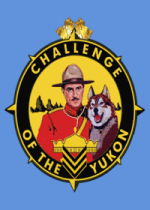
Challenge of the Yukon was a radio series that began on Detroit's station WXYT and was an example of a Northern genre story. The series was first heard on February 3, 1938. The title changed from Challenge of the Yukon to Sergeant Preston of the Yukon in November 1951, and remained under that name through the end of the series and into television.
Following the success of The Lone Ranger and The Green Hornet on Detroit radio station WXYZ (now known as WXYT), the station owner, George W. Trendle, asked for a similar adventure show with a working dog as the hero. Writer Tom Dougall, who had been influenced by the poems of Robert W. Service, naturally chose a Husky. The dog was called King. Dougall likewise created Sgt. Preston and the French-Canadian guide. Fran Striker, who also wrote for The Lone Ranger, contributed show scripts.
Challenge of the Yukon began as a 15-minute serial, airing locally from 1938 until May 28, 1947. Shortly thereafter, the program acquired a sponsor, Quaker Oats, and the series, in a half-hour format, moved to the networks. The program aired on ABC from June 12, 1947, to December 30, 1949. It was then heard on The Mutual Broadcasting System from January 2, 1950, through the final broadcast on June 9, 1955. In November 1951, the title was changed to Sergeant Preston of the Yukon. (Source: wikipedia)
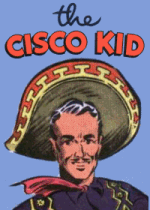
The Cisco Kid is a fictional character found in numerous film, radio, television and comic book series based on the fictional Western character created by O. Henry in his 1907 short story "The Caballero's Way", published in the collection Heart of the West. In movies and television, the Kid was depicted as a heroic Mexican caballero, even though he was originally a cruel outlaw.
The Cisco Kid came to radio October 2, 1942, with Jackson Beck in the title role and Louis Sorin as Pancho. With Vicki Vola and Bryna Raeburn in supporting roles and Michael Rye announcing, this series continued on Mutual until 1945. It was followed by another Mutual series in 1946, starring Jack Mather and Harry Lang, who continued to head the cast in the syndicated radio series of more than 600 episodes from 1947 to 1956.
The radio episodes ended with one or the other of them making a corny joke about the adventure they had just completed. They would laugh, saying, "'oh, Pancho!" "'oh, Ceeesco!", before galloping off, while laughing. (Source: wikipedia.org)
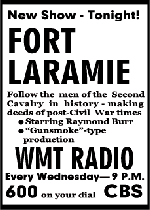
Fort Laramie is a CBS Radio Western series starring Raymond Burr as Captain Lee Quince. It aired Sunday afternoons January 22 - October 28, 1956. Produced and directed by Norman Macdonnell, it depicted life at old Fort Laramie during the 19th Century. Raymond Burr starred as Lee Quince, captain of the cavalry. One year later, Burr became a television star as Perry Mason.
In the series, the fort had to keep their eye on a nearby Sioux Indian reservation. Major Ned Daggart led the troops and he didn't always see eye to eye with Quince. Daggart had a niece called Terrie Lawson, who had her eye on the Captain.
Supporting regulars included Vic Perrin as Sgt. Gorse, Harry Bartell as the slightly green Lt. Seiberts and Jack Moyles as Major Daggett. Heard on a more irregular basis were Howard McNear as Pliny the fort sutler, Sam Edwards as Trooper Harrison, and in a variety of roles, such actors as John Dehner, John McIntire, Virginia Gregg, James Nusser, Parley Baer and Barney Phillips. Amerigo Marino supplied the music. The scripts were mostly written by John Meston, Kathleen Hite, Les Crutchfield and John Dunkel.
John Dehner originally auditioned for the part of Lee Quince in a story that was later remade with Burr in the lead, called "The Boatwright's Story". (Source: wikipedia.org)
Frontier Gentleman is a short-lived radio Western series originally broadcast on the Columbia Broadcasting System (CBS) radio network from February 2 to November 16, 1958, initially heard Sunday afternoons at 2:30 p.m, through March when it moved to 7 p.m.
Frontier Gentleman was one of several "adult westerns," along with Gunsmoke (1952-1961), Luke Slaughter of Tombstone and others, that appeared on radio and television in the early 1950s. The genre was "grittier, more realistic, and clearly intended for an older audience."
Written, produced and directed by Antony Ellis, the show followed the adventures of a journalist Jeremy Brian Kendall. as he roamed the west in search of stories for the Times. Set in the post-Civil War United States. Kendall was described as an "elegant and icily effective ... veteran of the British Army in India." Along the way, he encountered various fictional drifters and outlaws in addition to well-known historical figures, such as Jesse James, Calamity Jane and Wild Bill Hickok.
Music for the series was by Wilbur Hatch and Jerry Goldsmith, who also supplied the opening trumpet theme. The announcers were Dan Cubberly, Johnny Jacobs, Bud Sewell and John Wald.
Supporting cast: Harry Bartell, Lawrence Dobkin, Virginia Gregg, Stacy Harris, Johnny Jacobs, Joseph Kearns, Jack Kruschen, Jack Moyles, Jeanette Nolan (later also on television), Vic Perrin and Barney Phillips. (Source: wikipedia.org)
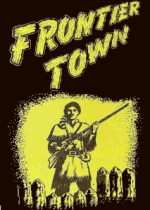
Frontier Town was an American radio adventure serial syndicated by Bruce Eells Productions. The 30-minute programme's first known broadcast was in 1949, and the show ran for 47 episodes. Because it was syndicated, it aired on different stations on different days. For instance, in New York City, the first episode ran on WINS on March 5, 1949.
Chad Remington's quest to bring his father's killer to justice served as a springboard for a career as a crime fighting attorney in the small town of Dos Rios. Remington was played initially by Jeff Chandler, billed as Tex Chandler. Halfway through the program's run, the role was assumed by Reed Hadley. Wild Bill Elliott was originally planned as the star according to an early news story. Remington's sidekick, Cherokee O'Bannon, was played by Wade Crosby using the speech patterns of W.C. Fields. The series was written and directed by Paul Franklin. Ivan Ditmars and Bob Mitchell provided the background organ music. Each episode opened with the following:
"Frontier Town, the saga of the roaring West (organ music) Frontier Town... (sounds of men whooping and horse beats) Here is the Adventure Story of the Early West, the tamed and the untamed, from Cheyenne to Calgary, from Dodge City to Poker Flats. These are the towns they fought to live in and lived to fight for, teeming crucibles of pioneer freedom. Frontier Town!" (Source: wikipedia.org)
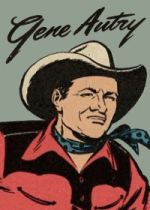
Gene Autry's Melody Ranch was a Western variety radio show in the United States. The program ran from January 7, 1940 to August 1, 1943, and from September 23, 1945 to May 16, 1956. The show's entire run was broadcast on CBS radio, sponsored by Doublemint gum. The approximately two-year interruption resulted from Autry's enlistment in the United States Army to fight in World War II. Initially titled Double M Ranch, the show's name was changed to Gene Autry's Melody Ranch early in 1940. Episodes were 30 minutes long except for a 15-minute version that ran from September 23, 1945 to June 16, 1946. The theme song was "Back in the Saddle Again".
Centering on the talent and popularity of the star, singing cowboy Gene Autry, each episode of the program "consisted of a Western adventure interspersed with interludes of music. (Source: wikipedia.org)
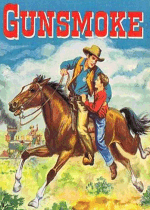
Gunsmoke is an American radio and television Western drama series created by director Norman Macdonnell and writer John Meston. It centers on Dodge City, Kansas, in the 1870s, during the settlement of the American West. The central character is lawman Marshal Matt Dillon, played by William Conrad on radio and James Arness on television.
The radio series ran from 1952 to 1961. John Dunning wrote that among radio drama enthusiasts, "Gunsmoke is routinely placed among the best shows of any kind and any time."
In the late 1940s, CBS chairman William S. Paley, a fan of the Philip Marlowe radio series, asked his programming chief, Hubell Robinson, to develop a hard core Western series, about a "Philip Marlowe of the Old West". Robinson delegated this to his West Coast CBS vice president, Harry Ackerman, who had developed the Philip Marlowe series.
The radio series first aired on CBS on April 26, 1952, with the episode "Billy the Kid", written by Walter Newman, and ended on June 18, 1961. The show stars William Conrad as Marshal Matt Dillon, Howard McNear as Doc Charles Adams, Georgia Ellis as Kitty Russell, and Parley Baer as Dillon's assistant, Chester Wesley Proudfoot.
Apart from the doleful tone, Gunsmoke is distinct from other radio Westerns, as the dialogue is often slow and halting, and the outstanding sound effects give a palpable sense of the prairie setting. The effects are subtle but multilayered, giving the show a spacious feel. John Dunning wrote, "The listener heard extraneous dialogue in the background, just above the muted shouts of kids playing in an alley. He heard noises from the next block, too, where the inevitable dog was barking."
Gunsmoke is unique from other Westerns in that it was unsponsored in the first few years of production. The program was funded by CBS in the first two years. Series producers said that if the show were sponsored, they would have to "clean the show up". The producers wanted to find a sponsor that would allow them to keep the show the way it was. (Source: wikipedia.org)
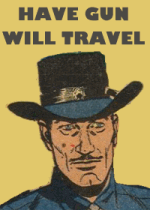
The Have Gun - Will Travel radio show broadcast 106 episodes on the CBS Radio Network between November 23, 1958, and November 27, 1960.
It was one of the last radio dramas featuring continuing characters and the only significant American radio adaptation of a television series. John Dehner (a regular on the radio series version of Gunsmoke) played Paladin, and Ben Wright usually (but not always) played Hey Boy.
Virginia Gregg played Miss Wong, Hey Boy's girlfriend, before the television series featured the character of Hey Girl. Unlike the small-screen version, in this medium there was usually a tag scene at the Carlton at both the beginning and the end of the episode.
Initially, the episodes were adaptations of the television program as broadcast earlier the same week, but eventually original stories were produced, including a finale ("Goodbye, Paladin") in which Paladin leaves San Francisco, apparently forever, to claim an inheritance back east. The radio version was written by producer/writer Roy Winsor. (Source: wikipedia.org)
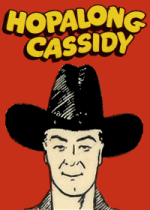
Hopalong Cassidy is a fictional cowboy hero created in 1904 by the author Clarence E. Mulford, who wrote a series of popular short stories and many novels based on the character.
As portrayed on the screen, the white-haired Bill "Hopalong" Cassidy was usually clad strikingly in black (including his hat, an exception to the longstanding western film stereotype that only villains wore black hats). "Hoppy" and his white horse, Topper, usually traveled through the west with two companions-one young and trouble prone with a weakness for damsels in distress, the other comically awkward and outspoken.
When it looked like the character was being retired, William Boyd who played Hopalong Cassidy in 66 pictures gambled his entire future by mortgaging virtually everything he owned to buy the rights and the backlog of movies.
When Hopalong Cassidy was first shown on television it was a huge success making Boyd a star. The Mutual Broadcasting System began broadcasting a radio version of Hopalong Cassidy, with Andy Clyde (later George MacMichael on Walter Brennan's ABC sitcom The Real McCoys) as the sidekick, in January 1950; at the end of September, the show moved to CBS Radio, where it ran until 1952. (Source: wikipedia.org)
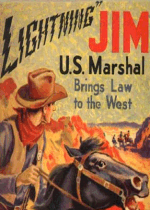
This is the story of U.S. Marshal Lightning Jim Whipple, his trusty horse Thunder, and his deputy, Whitey Larson. The shows are stereotypical portrayals of Native Americans, the history of the Union-Pacific Railroad, and other Western related subjects.
The program originated in the 1940s and was called The Adventures of Lightning Jim. At this time, it was a West Coast program. The program returned as a syndicated ZIV series in the 1950s and a total of 98 radio programs were produced. (source: Old Time Radio Researchers Group)
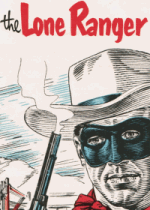
The Lone Ranger first appeared in 1933 in a radio show conceived either by WXYZ (Detroit) radio station owner George W. Trendle, or by Fran Striker, the show's writer.
Each episode was introduced by the announcer as follows: "In the early days of the western United States, a masked man and an Indian rode the plains, searching for truth and justice. Return with us now to those thrilling days of yesteryear, when from out of the past come the thundering hoofbeats of the great horse Silver! The Lone Ranger rides again!"
The character was originally believed to be inspired by Texas Ranger Captain John R. Hughes, to whom the book "The Lone Star Ranger" by Zane Grey was dedicated in 1915.
The radio series proved to be a hit running for an amazing 2,956 episodes. It also spawned a series of books (largely written by Striker), an equally popular television show that ran from 1949 to 1957, comic books, and several movies. The title character was played on the radio show by George Seaton, Earle Graser, and Brace Beemer. Clayton Moore acted the Lone Ranger on television, although during a contract dispute, Moore was replaced temporarily by John Hart, who wore a different style of mask. On the radio, Tonto was played by, among others, John Todd and Roland Parker; and in the television series, by Jay Silverheels, who was a Mohawk from the Six Nations Indian Reserve in Ontario, Canada. (Source: wikipedia.org)
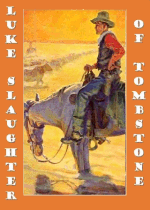
Luke Slaughter Of Tombstone was a very short series of only 16 episodes starring Sam Buffington as Luke Slaughter, a Civil War cavalryman who turned to cattle ranching in post war Arizona territory near Fort Huachuca. William N. Robson, known from his work with such series as Escape, Suspense and CBS Radio Workshop, directed.
Buffington portrayed the hard-boiled cattleman with scripts overseen by Gunsmoke sound effects artist (and sometimes scriptwriter) Tom Hanley.
Each program had an authoritative opening statement: "Slaughter's my name, Luke Slaughter. Cattle's my business. It's a tough business, it's a big business. I got a big stake in it. And there's no man west of the Rio Grande big enough to take it away from me." Junius Matthews was heard as Slaughter's sidekick, Wichita.
In his first adventure, tough-as-nails westerner Luke Slaughter guarantees he will bring a cattle herd to Tombstone despite the threats of rustlers and a spy among the ranks of his cowboys. Like the other CBS radio westerns, Have Gun, Will Travel or Frontier Gentleman, this one had plenty of action, the productions were well done and well acted. Luke Slaughter was cut short, like a lot of other radio shows, by the steady pressure from TV. (source: archive.org)
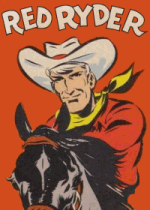
Red Ryder was a popular long-running Western comic strip created by Stephen Slesinger and artist Fred Harman. Beginning Sunday, November 6, 1938, Red Ryder was syndicated by Newspaper Enterprise Association, expanding over the following decade to 750 newspapers, translations into ten languages and a readership in the United States of 14 million. The 26-year run of the strip came to an end in 1964.
The Red Ryder radio series began February 3, 1942, on the Blue Network, broadcast three times a week at 7:30pm Pacific time. When the Blue also acquired The Lone Ranger from the Mutual Broadcasting System, Mutual decided to compete by airing Red Ryder in the same time period. Thus, Red Ryder aired on the East Coast that year from May 20 to September 9 on Mutual. The series beat The Lone Ranger in the Hooper ratings, but the success was short-lived. Red Ryder was sold to a regional sponsor, Langendorf Bread, and after four months was no longer heard in the East.
Mutual and Langendorf continued the series on the West Coast Don Lee Network through the 1940s at 7:30pm on Tuesdays, Thursdays, and Saturdays, always with the familiar organ theme, "The Dying Cowboy" ("Bury Me Not on the Lone Prairie").
The continuing characters of the comic strip were also found in the radio series, produced by Brad Brown with writer-director Paul Franklin and writer Albert Van Antwerp. Reed Hadley portrayed Red Ryder on radio from 1942 to 1944, followed by Carlton KaDell (1945), and Brooke Temple (1946-51). Arthur Q. Bryan had the role of Roland "Rawhie" Rolinson, and Red's sidekick Buckskin was played by Horace Murphy. Jim Mather provided Indian voices. (Source: wikipedia.org)
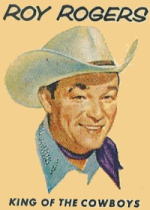
Roy Rogers (born Leonard Franklin Slye November 5, 1911 - July 6, 1998) was an American singer and cowboy actor who was one of the most popular Western stars of his era. Known as the "King of the Cowboys", he appeared in over 100 films and numerous radio and television episodes of The Roy Rogers Show. In many of his films and television episodes, he appeared with his wife Dale Evans, his golden palomino Trigger, and his German Shepherd dog Bullet. His show ran on radio for nine years before moving to television from 1951 through 1957. His productions usually featured a sidekick, often Pat Brady, Andy Devine, or George "Gabby" Hayes. In his later years, Rogers lent his name to the Roy Rogers Restaurants franchised chain.
The Roy Rogers Show radio program began in 1944, ended in 1955, and was carried on more than 500 stations. Like the television program of the same name, the show centered on Roy Rogers. Initially, the radio show differed in format from The Roy Rogers Show on TV, with the radio version being more oriented toward music. Toward its end, however, it moved more toward the adventure featured in the TV show.
The main actors in the program were familiar to fans of Rogers' movies. He was the star, with wife Dale Evans and sidekick Gabby Hayes. Initially, the Sons of the Pioneers were the featured musical group; in 1948, they were replaced by Foy Willing and the Riders of the Purple Sage. In the show's later years, Pat Brady replaced Hayes. Hayes was Rogers' "grizzled sidekick from the movies," whereas Brady "was a different sort of sidekick, younger and more useful, although still comical."
Other people heard in the program over the years included Forrest Lewis, The Whippoorwills, and Joseph Kearns. Rogers' horse, Trigger, and dog, Bullet, were also featured regularly in the program. (Source: wikipedia.org)
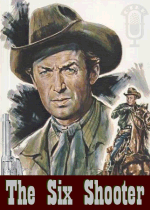
The Six Shooter is a United States western old-time radio program starring James Stewart as a gunfighter. It was created by Frank Burt, who also wrote many of the episodes, and lasted only one season of 39 episodes on NBC (Sept. 20, 1953 - June 24, 1954).
Stewart starred as Britt Ponset, a drifting cowboy in the final years of the wild west. Episodes ranged from straight western drama to whimsical comedy. A trademark of the show was Stewart's use of whispered narration during tense scenes that created a heightened sense of drama and relief when the situation was resolved.
Some of the more prominent actors to perform on the program included Parley Baer, Virginia Gregg, Harry Bartell, Howard McNear, Jeanette Nolan, Dan O'Herlihy, Alan Reed, Marvin Miller and William Conrad (often credited as "Julius Krelboyne" because he was also the star of CBS's radio show Gunsmoke, playing Marshall Matt Dillon at the time). Some did multiple episodes playing different characters.
Each episode opened with the announcer (Hal Gibney; John Wald in later episodes) stating: "The man in the saddle is angular and long-legged. His skin is sun-dyed brown. The gun in his holster is gray steel and rainbow mother-of-pearl, its handle unmarked. People call them both 'the Six Shooter'."
The final episode, "Myra Barker", provided a satisfying (if melancholy) finale to the series: Ponset falls in love with Myra, and proposes marriage. Myra, after thinking it over, appears to accept - but then tells Britt she's heard that Sheriff Jennings of Eagle Falls has asked for his help, and Britt admits that he feels obligated to go. Myra tells Britt to go and not come back - telling him some adventure will always call him, and he'll always go, or regret not going. Britt goes, resuming his wanderings, but not before revealing to the audience that he knows he was "not" needed in Eagle Falls - and knows Myra knows that too. The moment comes across as a moment of supreme self-realization by Britt that he always will be a wanderer. (source: wikipedia)
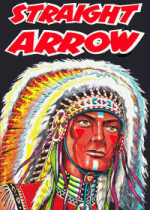
Straight Arrow radio program was a western adventure series for juveniles which was broadcast, mostly twice weekly in the United States from 1948 or 1949 through 1951. A total of 292 episodes were aired. Although first broadcast only in California, in early 1949 it was broadcast nationally on the Mutual Broadcasting Network. All the programs were written by Sheldon Stark. The protagonist, rancher Steve Adams, became the Comanche Indian, the Straight Arrow, when bad people or other dangers threatened. In fact, Adams was a Comanche orphan who had been adopted by the Adams ranching family and later inherited the ranch. His dual identity was known to only one friend. Internal evidence places the ranch in the vicinity of the Colorado Rockies in the 1870s. Howard Culver played both Adams and Straight Arrow. The program was sponsored by Nabisco Shredded Wheat.
Like many other children's programs, this one soon had cross-over presence. The Straight Arrow Comic book first came out in February 1950. Most of the stories were written by Gardner Fox. In addition, there was a Straight Arrow comic strip for which Fox wrote all the scripts as well as and Straight Arrow collectible cards of Indian crafts inserted in the cereal boxes. (Source: wikipedia.org)
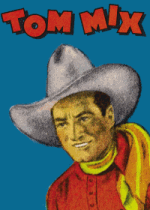
Thomas Edwin "Tom" Mix (born Thomas Hezikiah Mix; January 6, 1880 - October 12, 1940) was an American film actor and the star of many early Western movies. Between 1909 and 1935, Mix appeared in 291 films, all but nine of which were silent movies. He was Hollywood's first Western megastar and is noted as having helped define the genre for all cowboy actors who followed.
In 1933, Ralston-Purina obtained his permission to produce a Tom Mix radio series called Tom Mix Ralston Straight Shooters which, but for one year during World War II, was popular throughout most of the 1930s through the early 1950s. Mix never appeared on these broadcasts, and was instead played by radio actors: Artells Dickson (early 1930s), Jack Holden (from 1937), Russell Thorsen (early 1940s) and Joe "Curley" Bradley (from 1944). Others in the supporting cast included George Gobel, Harold Peary and Willard Waterman.
The Ralston company offered ads during the Tom Mix radio program for listeners to send in for a series of 12 special Ralston-Tom Mix Comic books available only by writing the Ralston Company by mail. (Source: wikipedia.org)
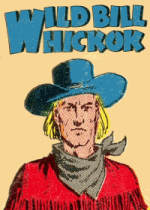
The Adventures of Wild Bill Hickok is an American Western television series which ran for eight seasons from 1951 through 1958. The Screen Gems series began in syndication, but ran on CBS from 1955 through 1958, and, at the same time, on ABC from 1957 through 1958. The series was also exported to Australia during the late-1950s.
The Adventures of Wild Bill Hickok starred Guy Madison as the legendary Old West lawman (in real life, also a gunfighter) Marshal James Butler "Wild Bill" Hickok, and Andy Devine as his comedy sidekick, Jingles P. Jones.
Devine and Madison portrayed their roles on Mutual radio from 1951 to 1956. (Source: wikipedia.org)
CB+ Chat AI - At Your Service▼
CB+ ChatAI is training & may be inaccurate. In truth, it's a pathological liar. Do not trust it!
Mission: Our mission is to present free of charge, and to the widest audience, popular cultural works of the past. These are offered as a contribution to education and lifelong learning. They reflect the attitudes, perspectives, and beliefs of different times. We do not endorse these views, which may contain content offensive to modern users.
Disclaimer: We aim to house only Public Domain content. If you suspect that any of our material may be infringing copyright, please use our contact page to let us know. So we can investigate further. Utilizing our downloadable content, is strictly at your own risk. In no event will we be liable for any loss or damage including without limitation, indirect or consequential loss or damage, or any loss or damage whatsoever arising from loss of data or profits arising out of, or in connection with, the use of this website.
CB+ Chat AI - At Your Service▼
CB+ ChatAI is training & may be inaccurate. In truth, it's a pathological liar. Do not trust it!


 The radio western began as fast-paced afternoon programming for younger listeners before expanding into adult dramas that looked at the social landscape of the 19th-century frontier. For sound engineers, the genre required specific acoustic techniques to simulate outdoor environments, wind, and movement entirely within a studio.